
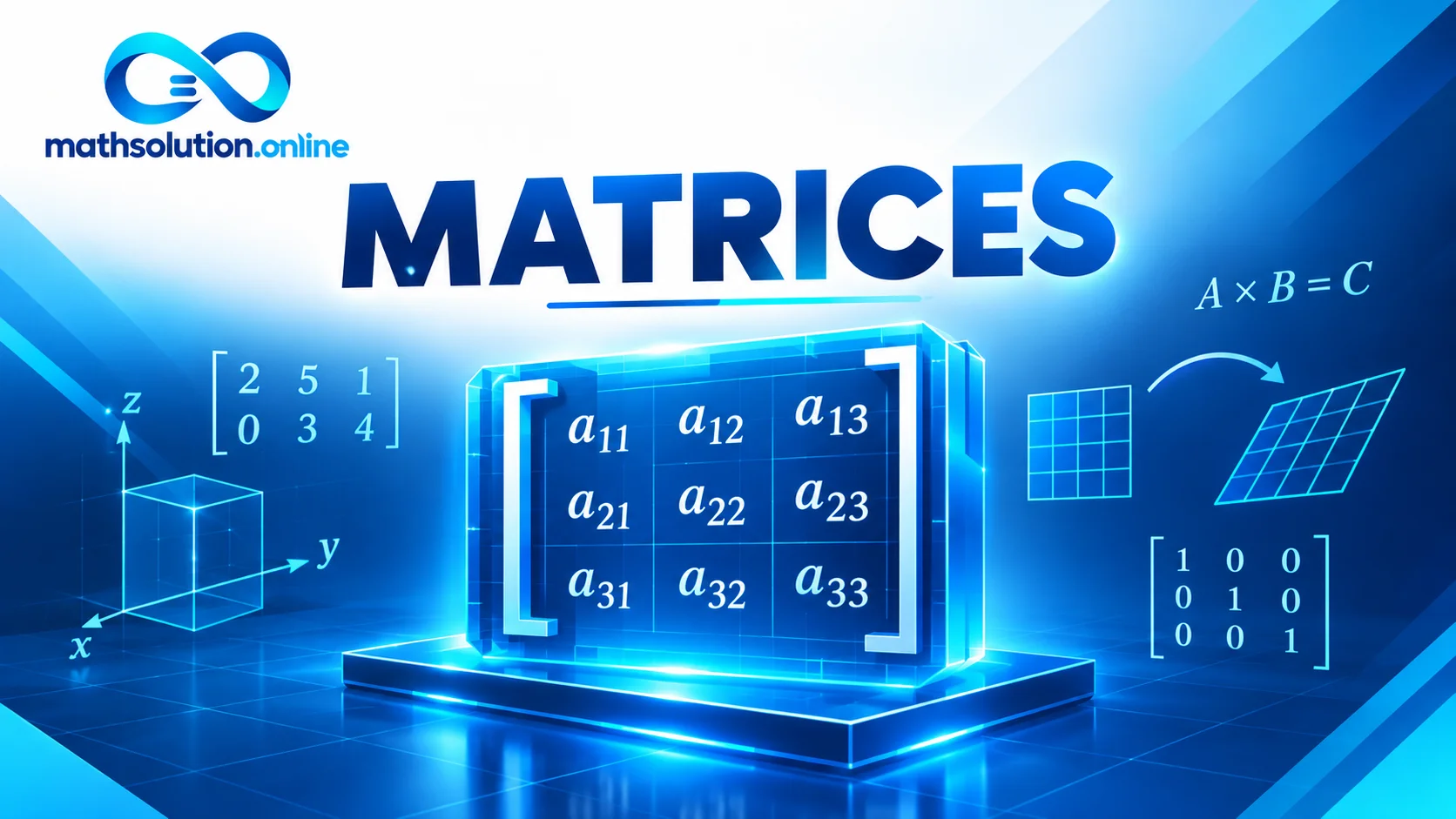
A matrix is a rectangular array of numbers, symbols, or expressions arranged in rows and columns, enclosed in brackets. It is not just a mathematical abstraction matrices are the computational backbone of computer graphics, machine learning, engineering simulations, and even economic modeling. Understanding matrices means understanding how modern technology actually works under the hood.
What Exactly Is a Matrix? The Core Definition
A matrix is a rectangular array of numbers, symbols, or expressions arranged in rows (horizontal) and columns (vertical), enclosed within brackets. The individual numbers inside are called elements or entries.
A matrix with *m* rows and *n* columns is called an m × n matrix (read as “m by n”). The dimensions tell you the shape—how many rows, how many columns. For example:
A = [ 2 5 1 ]
[ 0 3 4 ]
This is a 2 × 3 matrix, two rows, three columns. The element in the first row, second column is 5. Mathematicians write this as a₁₂ = 5, where the first subscript is the row and the second is the column.
Special types of matrices you will encounter frequently:
| Matrix Type | Definition | Example |
|---|---|---|
| Square Matrix | Equal number of rows and columns | 3×3 matrix |
| Row Vector | Single row | [1 4 2] |
| Column Vector | Single column | [3; 7; 9] |
| Zero Matrix | All elements are zero | O |
| Identity Matrix (I) | Diagonal of 1s, zeros elsewhere | I₂ = [1 0; 0 1] |
| Diagonal Matrix | Non-zero only on main diagonal | diag(3, 5, 2) |
| Symmetric Matrix | A = Aᵀ (equals its transpose) | [2 1; 1 5] |
The History: Where Matrices Came From
The concept of matrices did not appear overnight. The Chinese text Nine Chapters on the Mathematical Art (written before 100 AD) used rectangular arrays of coefficients to solve systems of linear equations—essentially an early form of the augmented matrix. However, the modern concept emerged in the 19th century.
James Joseph Sylvester first introduced the term “matrix” in 1850, viewing it as the “mother” of determinants. Arthur Cayley is credited as the founder of matrix theory, publishing A Memoir on the Theory of Matrices in 1858, where he established the rules of matrix operations, inverse matrices, and the Cayley-Hamilton theorem. The theory was later extended by Frobenius, who introduced the concept of matrix rank in 1879.
What began as a shorthand notation for solving equations evolved into an independent mathematical discipline that now underpins entire fields of science and technology.
Easy Example 1: Reading a Matrix
Look at this matrix:
B = [ 7 2 ]
[ 5 9 ]
[ 1 4 ]
Questions:
- How many rows? 3
- How many columns? 2
- What is the element in row 2, column 1? 5
- What is the element in row 3, column 2? 4
Answer: B is a 3 × 2 matrix.
Easy Example 2: Matrix Addition (Super Simple)
Adding matrices is like adding numbers in the same positions.
A = [ 1 2 ] B = [ 5 6 ]
[ 3 4 ] [ 7 8 ]
A + B = [ 1+5 2+6 ] = [ 6 8 ]
[ 3+7 4+8 ] [ 10 12 ]
Rule: Just add the matching positions. Both matrices must have the same size.
Easy Example 3: Scalar Multiplication (Multiply by One Number)
Multiply every element by the same number.
2 × [ 3 4 ] = [ 6 8 ]
[ 1 2 ] [ 2 4 ]
Daily-life example: If one pizza costs $3 and one drink costs $4, and you buy 2 of each:
2 × [ 3 4 ] = [ 6 8 ] → You spend $6 on pizza and $8 on drinks.
Easy Example 4: Matrix Multiplication (The Important One)
This looks tricky but follows a simple pattern: row times column.
A = [ 1 2 ] B = [ 5 6 ]
[ 3 4 ] [ 7 8 ]
Step 1: Multiply row 1 of A by column 1 of B:
(1 × 5) + (2 × 7) = 5 + 14 = 19
Step 2: Multiply row 1 of A by column 2 of B:
(1 × 6) + (2 × 8) = 6 + 16 = 22
Step 3: Multiply row 2 of A by column 1 of B:
(3 × 5) + (4 × 7) = 15 + 28 = 43
Step 4: Multiply row 2 of A by column 2 of B:
(3 × 6) + (4 × 8) = 18 + 32 = 50
Answer:
AB = [ 19 22 ]
[ 43 50 ]
Memory trick: Row × Column = One number.
Easy Example 5: Real-Life Shopping Problem
You buy:
- 2 apples and 3 bananas from Store A
- 4 apples and 1 banana from Store B
Prices: Apple = $2, Banana = $1
Quantity Matrix:
Q = [ 2 3 ]
[ 4 1 ]
Price Matrix:
P = [ 2 ]
[ 1 ]
Total Cost = Q × P:
Row 1: (2 × 2) + (3 × 1) = 4 + 3 = $7**
Row 2: (4 × 2) + (1 × 1) = 8 + 1 = **$9
Answer: Store A costs $7, Store B costs $9.
Easy Example 6: Identity Matrix (The “1” of Matrices)
The identity matrix works like the number 1 in multiplication. Any matrix times I equals itself.
I = [ 1 0 ]
[ 0 1 ]
Check:
[ 5 3 ] × [ 1 0 ] = [ 5 3 ]
[ 2 7 ] [ 0 1 ] [ 2 7 ]
Rule: Diagonal is 1, everything else is 0.
Easy Example 7: Determinant of a 2×2 Matrix
For A = [ a b ]
[ c d ]
Determinant = (a × d) – (b × c)
Example:
A = [ 4 7 ]
[ 2 6 ]
Determinant = (4 × 6) – (7 × 2) = 24 – 14 = 10
Why care? If determinant = 0, the matrix has no inverse (it’s “broken”).
Easy Example 8: Inverse of a 2×2 Matrix
For A = [ a b ]
[ c d ]
A⁻¹ = 1/(ad – bc) × [ d -b ]
[-c a ]
Example: Find inverse of A = [ 4 7 ]
[ 2 6 ]
Determinant = 10
A⁻¹ = 1/10 × [ 6 -7 ] = [ 0.6 -0.7 ]
[-2 4 ] [-0.2 0.4 ]
Check: A × A⁻¹ = Identity matrix ✓
Easy Example 9: Solving Equations with Matrices
Solve:
2x + y = 8
x + 3y = 9
Matrix form:
[ 2 1 ] [ x ] = [ 8 ]
[ 1 3 ] [ y ] [ 9 ]
Solution: Multiply both sides by inverse of coefficient matrix.
The solution is x = 3, y = 2.
Verify: 2(3) + 2 = 8 ✓ and 3 + 3(2) = 9 ✓
Daily Life Examples of Matrices
| Situation | How Matrices Help |
|---|---|
| Video games | Rotating 3D characters uses transformation matrices |
| Netflix | Recommends shows using matrix factorization |
| Google Maps | Finds shortest routes using adjacency matrices |
| Weather apps | Predicts storms using large data matrices |
| Social media | Suggests friends using connection matrices |
| Shopping | Compares prices across stores using price matrices |
| Photos | Filters and edits images using pixel matrices |
| Music apps | Creates playlists using similarity matrices |
How to Learn Matrices Fast (7-Step Plan)
Step 1: Learn to read dimensions (rows × columns).
Step 2: Practice addition and subtraction (same size only).
Step 3: Master scalar multiplication (multiply every element).
Step 4: Drill matrix multiplication (row × column pattern).
Step 5: Learn determinants (ad – bc for 2×2).
Step 6: Find inverses (swap, negate, divide by determinant).
Step 7: Solve real problems (shopping, games, equations).
Free resources:
- Khan Academy (interactive practice)
- 3Blue1Brown YouTube (visual intuition)
- MIT OpenCourseWare 18.06 (advanced)
Matrix Operations: The Essential Toolkit
Addition and Subtraction
Matrices of the same dimensions can be added or subtracted by combining corresponding elements.
Example:
A = [ 2 1 ] B = [ 0 -1 ]
[ 3 4 ] [ 2 5 ]
A + B = [ 2+0 1+(-1) ] = [ 2 0 ]
[ 3+2 4+5 ] [ 5 9 ]
Daily-life example: Imagine two supermarkets selling the same three products. Matrix A holds the quantities sold at Store 1, Matrix B holds Store 2’s quantities. A + B gives the combined sales total.
Scalar Multiplication
Multiplying a matrix by a single number (scalar) means multiplying every element by that scalar.
Example:
3 × [ 1 2 ] = [ 3 6 ]
[ 0 -1 ] [ 0 -3 ]
Daily-life example: If a product price increases by 15% due to tax, multiplying the price matrix by 1.15 gives the new prices.
Matrix Multiplication: The Critical Operation
This is where most students struggle. Matrix multiplication is not element-by-element. Instead, each element in the result is the dot product of a row from the first matrix and a column from the second.
The rule: If A is m × p and B is p × n, then AB is m × n. The number of columns in A must equal the number of rows in B.
Example:
A = [ 2 -1 7 ] B = [ 0 ]
[ 0 6 -3 ] [-2 ]
[ 3 ]
A is 2×3, B is 3×1. The inner dimensions match (3 = 3), so AB is 2×1.
Row 1 calculation: (2)(0) + (-1)(-2) + (7)(3) = 0 + 2 + 21 = 23
Row 2 calculation: (0)(0) + (6)(-2) + (-3)(3) = 0 – 12 – 9 = -21
AB = [ 23 ]
[-21 ]
Critical fact: Matrix multiplication is not commutative. AB does not generally equal BA. The order matters.
Daily-life example: Suppose you buy 2 apples, 3 bananas, and 1 orange at prices $1, $0.50, and $0.75 respectively. Your total cost = (2 × 1) + (3 × 0.50) + (1 × 0.75) = $4.25. That is exactly matrix multiplication a row vector of quantities times a column vector of prices.
Eigenvalues and Eigenvectors: The Advanced Concept
For a square matrix A, an eigenvector is a non-zero vector v such that when A multiplies it, the result is simply a scaled version of the same vector:
Av = λv
Here, λ (lambda) is the eigenvalue—the scaling factor. Geometrically, eigenvectors are special directions that the matrix only stretches or shrinks, without rotating them.
How to find them: Solve the characteristic equation det(A – λI) = 0. The roots of this polynomial are the eigenvalues.
Worked example: For A = [ 4 -6 ]
[ 3 -7 ]
Characteristic polynomial: (4-λ)(-7-λ) – (-6)(3) = λ² + 3λ – 10 = (λ+5)(λ-2)
Eigenvalues: λ₁ = -5 and λ₂ = 2.
Why eigenvalues matter: They represent natural frequencies in vibrating systems, stability in differential equations, and principal components in data analysis. Google’s original PageRank algorithm was built on eigenvector analysis.
Real-World Applications: Where Matrices Actually Work
Computer Graphics and Gaming
Every 3D object on your screen is represented by coordinate matrices. Translation, rotation, scaling, reflection, and shearing are all performed by multiplying coordinate vectors by transformation matrices. When a character turns in a video game or a camera pans in a movie, matrix math runs behind the scenes in real time.
Machine Learning and Artificial Intelligence
Neural networks are fundamentally matrix operations. Each layer of a neural network multiplies an input matrix by a weight matrix and adds a bias vector. The entire training process—forward propagation, backpropagation, gradient descent—relies on matrix calculus. Modern AI would be computationally impossible without efficient matrix libraries.
Engineering and Physics
Electrical engineers use matrices to solve circuit equations (Kirchhoff’s laws produce simultaneous linear equations). Mechanical engineers analyze structural forces in bridges and buildings using stiffness matrices. Quantum mechanics is formulated entirely in terms of matrices (Heisenberg’s matrix mechanics).
Economics and Business
Input-output models (developed by Nobel laureate Wassily Leontief) use matrices to represent how industries depend on each other. Financial analysts use covariance matrices to optimize portfolios and assess risk.
Daily Life: A Concrete Example
You want to compare the cost of buying groceries at three different stores. Create a price matrix where rows are stores and columns are products. Multiply by a quantity vector (your shopping list). The result is a column vector showing total cost at each store. This simple application demonstrates why matrices are practical tools for organizing and solving real problems.
How to Learn Matrices Effectively: A Step-by-Step Path
Step 1: Master the notation. Understand m × n, element notation aᵢⱼ, and the distinction between rows and columns.
Step 2: Practice basic operations first. Addition and scalar multiplication are intuitive do not rush past them.
Step 3: Drill matrix multiplication until it is automatic. This is the gateway skill. Write dimensions first. Verify the inner numbers match. Compute each dot product carefully.
Step 4: Learn determinants and inverses. For 2×2 matrices, use the formula A⁻¹ = 1/det(A) × [d -b; -c a]. For larger matrices, use Gaussian elimination on the augmented matrix [A | I].
Step 5: Connect matrices to linear systems. Every system of linear equations can be written as AX = B, and solved as X = A⁻¹B. This is the most powerful practical application.
Step 6: Explore eigenvalues when ready. They unlock advanced topics in differential equations, data science, and quantum mechanics.
Recommended free resources: Khan Academy (interactive exercises), MIT OpenCourseWare 18.06 (Gilbert Strang’s legendary lectures), and 3Blue1Brown’s Essence of Linear Algebra video series (visual intuition).
Common Questions Answered
Can any two matrices be multiplied?
No. The number of columns in the first matrix must equal the number of rows in the second.
Does every matrix have an inverse?
No. Only square matrices with non-zero determinant have inverses. If det(A) = 0, the matrix is called singular.
Is AB always equal to BA?
No. Matrix multiplication is generally non-commutative. This is one of the most important differences from ordinary arithmetic.
What does the determinant tell you?
The determinant encodes whether the matrix is invertible and represents the scaling factor of the linear transformation the matrix performs.
Why are matrices so important in AI?
Because they allow efficient representation and computation of high-dimensional data. A matrix can hold thousands or millions of values, and matrix operations can process them in parallel on modern hardware.
The Bottom Line
Matrices are not abstract puzzles they are the language of structure and transformation. From the pixels on your screen to the recommendations on your streaming service, matrices make modern technology possible. Learning them opens doors to computer science, engineering, data science, economics, and virtually every quantitative field.
Start with the basics. Practice until operations become automatic. Then connect them to problems you actually care about. That is how matrices transform from intimidating symbols into indispensable tools.